Turf Toe: How X-ray and MRI Grade a Big Toe Sprain
Turf toe is a sprain of the ligaments and capsule under the big toe joint, called the plantar plate or plantar capsuloligamentous complex. It is graded 1 to 3: a stretch, a partial tear, or a complete tear. X-rays look for sesamoid bones pulled out of place or broken; MRI shows how much of the plantar plate is torn, which is what separates rest from surgery.
Common Symptoms
- Sudden pain at the base of the big toe after it was forced upward while the heel was off the ground
- Swelling and bruising around and under the big toe joint, often spreading over the next day
- Painful, limited upward bending of the big toe and difficulty pushing off when walking or running
- Tenderness under the ball of the foot over the sesamoid bones
- Weakness pressing the big toe down, or the toe drifting or cocking up after a severe injury
- Lingering stiffness and push-off pain weeks later when the injury was more than a mild sprain
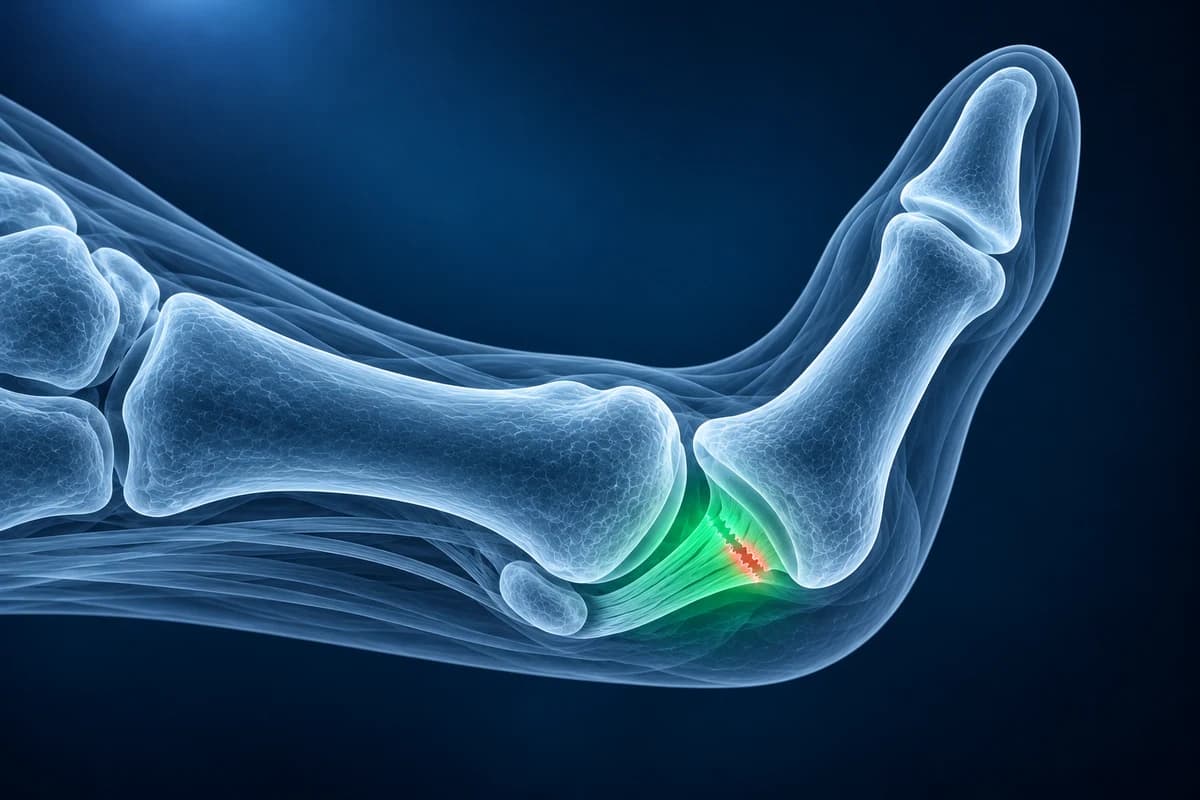
The name comes from American football on artificial turf, but the same injury happens in soccer, rugby, dance, gymnastics and on any hard surface where the forefoot is planted and the body falls forward over it. Below we explain the grades, the X-ray and MRI wording, and which findings change the plan. This is general information, not a diagnosis.
What are the grades of turf toe?
The most widely used scheme, described by Anderson and colleagues and reviewed by McCormick and Anderson, sorts the injury by how much of the plantar complex has failed:
- Grade 1: the plantar complex is stretched. Tenderness is localised, swelling is mild and you can usually still walk with little limp.
- Grade 2: a partial tear. Tenderness spreads, swelling and bruising are moderate, toe movement is painful and restricted, and limping is common.
- Grade 3: a complete tear. Pain, swelling and bruising are marked, the toe may feel unstable, and there can be a sesamoid fracture, separation of a bipartite sesamoid or cartilage damage on the metatarsal head.
Recovery time follows the grade. A stretch often allows a return to sport within days to a couple of weeks as pain allows, while a complete tear can take two months or more, and longer still if surgery is needed.
What does “plantar plate tear with retracted sesamoids” mean on your turf toe MRI report?
MRI is the test that grades the soft tissue. Radiologists read the plantar plate on sagittal (side-on) and short-axis images and describe it with phrases like these, each with a question to put to your clinician:
- “Sprain of the first MTP plantar plate with periligamentous edema”: the band is intact but surrounded by fluid, fitting a grade 1 injury. Ask how soon you can return to running and cutting.
- “Partial-thickness tear”: some fibres are torn, usually near the base of the toe bone where the plantar plate attaches, consistent with grade 2. Ask whether a boot is needed and how stability will be rechecked.
- “Full-thickness tear with retraction of the sesamoids”: the complex has torn through and the sesamoids have been pulled back toward the heel by the muscles, a grade 3 pattern. Ask whether a surgical opinion is advised.
- “Bone contusion of the first metatarsal head”: a bone bruise where the joint surfaces were jammed together. Ask whether the cartilage looks damaged, because that can lead to later stiffness.
- “Diastasis of a bipartite sesamoid”: the two parts of a split sesamoid have pulled apart, which behaves like a complete tear. Ask whether the gap is wider than on comparison views of the other foot.
- “Flexor hallucis longus intact”: the long tendon that bends the big toe has not torn; injury to it would weaken push-off. Ask whether toe-flexion strength was normal on examination.
To browse the slices yourself, load the study in the free foot MRI viewer; the sagittal images through the big toe show the plantar plate as a dark band under the joint. The general approach to these images is covered in how to read a foot MRI, and more report wording is translated in foot MRI report phrases explained.
What can an X-ray show after a turf toe injury?
The American College of Radiology Appropriateness Criteria for acute foot trauma start with X-rays, and they are the first study after a big toe injury. An X-ray cannot see the plantar plate itself, but it shows its effects:
- Sesamoids sitting further back toward the heel than on the uninjured foot, suggesting the plate has torn and they have retracted. Comparison views of both feet make this easier to see.
- A sesamoid fracture, or a gap between bipartite pieces that is wider than on the other side.
- A small fleck of bone pulled off the base of the toe or the metatarsal head.
- On a side view taken with the toe bent upward, sesamoids that fail to follow the toe forward, a sign of a complete tear.
The free foot X-ray viewer lets you put both feet side by side. If the X-ray is normal but pain and swelling are significant, MRI is the usual next step.
What We Look For After a Big Toe Sprain
- Continuity of the plantar plate and capsule under the first MTP joint
- Position of the sesamoids compared with the other foot or normal anatomy
- Sesamoid fracture or separation of a bipartite sesamoid
- Bone bruise or cartilage injury on the first metatarsal head
- Integrity of the flexor hallucis longus and the collateral ligaments of the big toe
- Sideways drift of the big toe after injury, sometimes called traumatic hallux valgus
When does turf toe need surgery?
Most turf toe injuries, including many grade 2 tears, heal with protection: taping or a stiff insert to stop the toe bending upward, a walking boot for more severe sprains, then gradual return to running and cutting. Surgery is considered for a minority, typically when imaging and examination show a large tear with an unstable joint, retracted sesamoids, a separated bipartite sesamoid or sesamoid fracture, a loose fragment in the joint, or the big toe drifting out of line.
Missed or undertreated turf toe can leave a stiff, painful joint and lead to arthritis, the condition described on the hallux rigidus page. Ongoing pain under the joint after a sprain can also come from the sesamoids themselves, which the sesamoiditis page covers. A similar injury under the second toe is a lesser toe plantar plate tear, which usually develops gradually rather than in one event.
Is an MRI worth it for a sprained big toe?
For an obvious mild sprain that improves quickly, many clinicians skip MRI. It is most useful when swelling and pain are marked, when the toe looks unstable or out of line, when X-rays show sesamoid displacement, or when an athlete needs a clear timeline. Cost and access vary; the foot MRI cost guide explains what drives the price.
If the main pain is on the top of the midfoot rather than at the big toe after a similar twisting fall, ask about a Lisfranc injury, which is easy to miss. Our ball-of-foot pain guide helps distinguish symptom locations around the big toe.
When should a big toe injury be seen urgently?
- You cannot take weight on the foot, or the toe looks deformed or dislocated.
- There is an open wound near the joint or bone is visible.
- The toe is pale, cold, blue or numb after the injury.
- Swelling and pain spread across the midfoot, or bruising appears on the sole of the arch.
An AI explanation can help you prepare questions for your clinician. It cannot confirm an injury or its grade on its own and is not a diagnosis.
Frequently Asked Questions
Is turf toe the same as a broken toe?
No. Turf toe is a ligament and capsule injury under the big toe joint. It can come with a broken sesamoid or a small bone flake, but the main damage is to soft tissue, which is why MRI rather than X-ray grades it.
How long does turf toe take to heal?
It depends on the grade. Mild sprains often settle within a couple of weeks, partial tears usually take longer, and complete tears can keep athletes out for two months or more. Returning before push-off is pain-free raises the risk of a longer setback.
Why does my MRI say the sesamoids are retracted?
The sesamoids are anchored to the base of the big toe by the plantar plate. When the plate tears completely, muscle pull draws them back toward the heel. Retraction is a sign of a high-grade injury and often leads to a surgical opinion.
Can turf toe cause arthritis later?
It can. Cartilage damage at the time of injury, or a joint that heals stiff or unstable, may lead to arthritis of the big toe joint over the following years. Good early protection and rehabilitation lower that risk.
Can AI grade my turf toe from an MRI?
Turf toe severity depends on plantar ligament damage and joint stability, assessed by examination and sometimes MRI. AI cannot assign a reliable injury grade.
Sources
- McCormick JJ, Anderson RB. Turf toe: anatomy, diagnosis, and treatment. Sports Health. 2010;2(6):487-494.
- Crain JM, Phancao JP, Stidham K. MR imaging of turf toe. Magn Reson Imaging Clin N Am. 2008;16(1):93-103.
- Expert Panel on Musculoskeletal Imaging. ACR Appropriateness Criteria: Acute Trauma to the Foot. J Am Coll Radiol.
- American Academy of Orthopaedic Surgeons. Turf Toe. OrthoInfo.
Understand your imaging before your next appointment
MRI, X-ray or CT from a CD, folder or ZIP. A PDF report or photos of the films work too.
Free to open and preview, no account needed. An optional AI report from $10 explains your images in plain language, with questions for your doctor.
Your raw files stay on this device. Only rendered images and minimal context are sent when you request an AI report.
Medical Disclaimer: This page is for informational and educational purposes only. It does not constitute medical advice, diagnosis, or treatment. AI-generated analysis may contain errors. Always consult a qualified healthcare professional for medical decisions. Full Disclaimer