
Hammer Toe, Claw Toe and Mallet Toe: Reading the Foot X-ray
Hammer toe, claw toe and mallet toe are named by which joint is bent. A hammer toe bends at the middle joint, a mallet toe at the joint nearest the nail, and a claw toe lifts at the base while curling at both toe joints. The shape is seen on examination; a standing X-ray adds whether the toe base has slipped out of its joint and whether arthritis is present.
Common Symptoms
- A lesser toe that stays bent at its middle joint, so the knuckle sticks up
- A painful corn on top of the bent knuckle where it rubs against the shoe
- A callus on the tip of the toe or under the ball of the foot behind it
- Difficulty straightening the toe by hand once the deformity has become fixed
- Several toes curling at once, lifting at their base and gripping downward at the tips
- Trouble finding shoes deep enough in the toe box to fit the raised toes
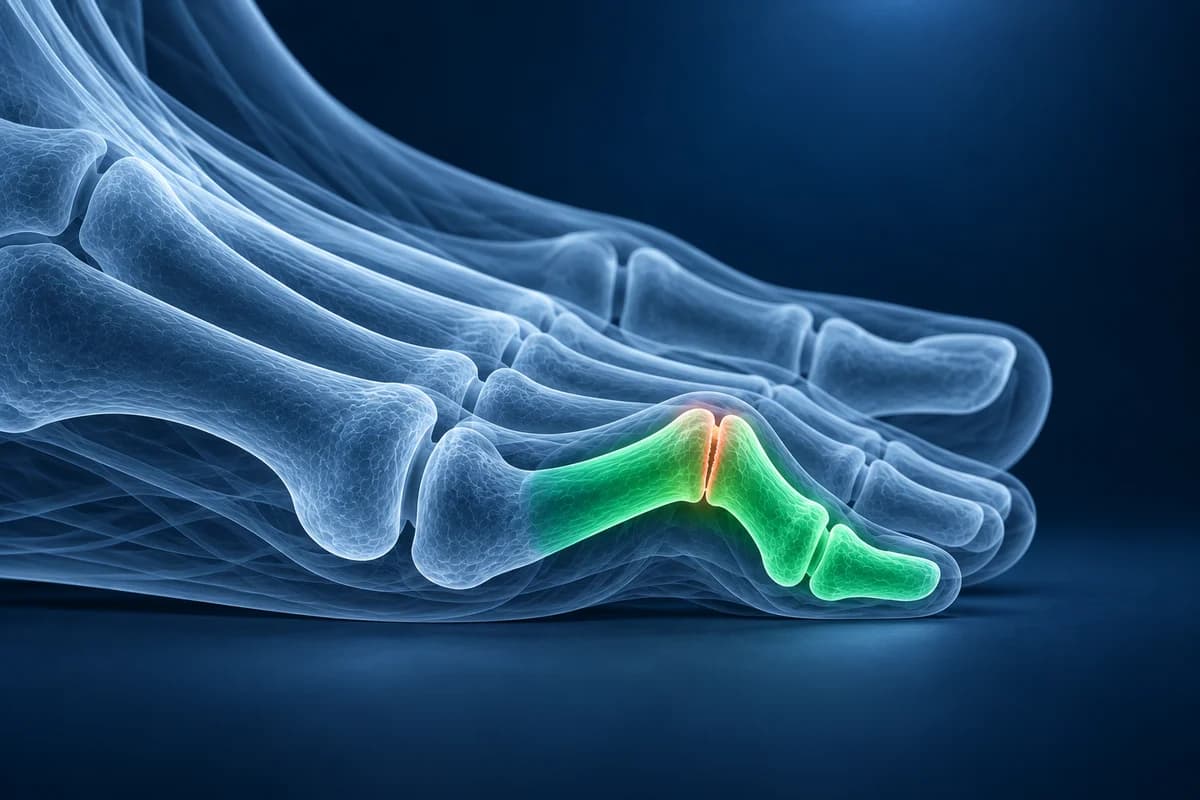
These lesser toe deformities are common, and an X-ray is usually part of confirming the picture and planning treatment. Below we describe how the three shapes differ, what a foot X-ray shows about each, the phrases your report may use, and which findings change treatment. This is educational information, not a diagnosis.
What is the difference between hammer toe, claw toe and mallet toe?
Each lesser toe has three joints: the base joint where it meets the foot (the metatarsophalangeal or MTP joint), the middle joint (the proximal interphalangeal or PIP joint) and the end joint (the distal interphalangeal or DIP joint). The review by Shirzad and colleagues defines the deformities by these joints:
- Hammer toe: the middle joint is bent downward, while the end joint is straight or bent back a little. It affects the second, third or fourth toe.
- Claw toe: the base joint is bent upward and both toe joints are bent downward, so the toe arches like a claw. It often affects several toes on both feet and can come from a nerve or muscle condition.
- Mallet toe: only the end joint is bent downward, so the tip of the toe presses into the ground and the nail can thicken.
Clinicians also sort each deformity as flexible, when the toe can still be pushed straight, or rigid, when it can no longer be straightened. That distinction comes from the examination, not the X-ray, and it is one of the main factors in choosing treatment.
What does a standing X-ray show in hammer toe?
The American College of Radiology Appropriateness Criteria for chronic foot pain start with radiographs. For toe deformities they are usually taken standing, so the toes sit as they do in daily life. The bend itself is obvious to the eye, so the X-ray is looking for what lies underneath:
- The position of the toe base on the metatarsal head. A base that has slid upward is subluxed; one that sits fully on top of the head is dislocated.
- Joint-space narrowing, spurs or erosions at the toe joints, which suggest arthritis.
- Metatarsal length, since a second metatarsal that reaches well beyond the first is linked with overload under the second toe.
- A bunion pushing the big toe under or against the second toe, which is often corrected in the same operation.
On the top-down view, a toe bent sharply upward at its base is seen end-on, so the toe bone looks like a short ring over the metatarsal head. The guide to reading a foot X-ray shows how the views fit together, and you can check toe alignment on your own films in the free foot X-ray viewer.
What does “dorsal subluxation of the second MTP joint” mean on your X-ray report?
Reports on lesser toe deformities describe joint position more than the bend you can already see. These phrases are the ones to understand, each with a question for your clinician. Our forefoot pain guide helps frame questions when the bent toe is not the only painful area.
- “Flexion deformity at the PIP joint”: the middle joint is bent downward, the hammer toe shape. Ask whether the toe is still flexible, since that decides between tendon and bone procedures.
- “Hyperextension at the MTP joint”: the base joint is bent upward, typical of a claw toe. Ask whether the base joint also needs releasing if surgery is planned.
- “Dorsal subluxation of the second MTP joint”: the toe base has partly slid up off the metatarsal head. Ask whether a plantar plate tear is suspected and whether ultrasound or MRI would help.
- “MTP joint dislocation”: the toe base sits fully on top of the metatarsal head. Ask whether the joint can be put back without shortening the metatarsal.
- “Degenerative changes at the interphalangeal joints”: arthritis in the small toe joints. Ask whether it explains the pain or is an incidental finding.
- “Periarticular erosions”: small bites of bone at the edge of a joint. Ask whether an inflammatory arthritis such as rheumatoid arthritis has been considered.
Other common foot X-ray wording is translated in foot X-ray report phrases explained.
What We Look For on a Toe Deformity X-ray
- Bend at the middle, end or base joint of each lesser toe on the side view
- Subluxation or dislocation of the toe base on the metatarsal head
- Joint-space narrowing, spurs or erosions at the small toe joints
- Relative length of the second metatarsal compared with the first
- Hallux valgus angle and crowding of the second toe
- Hardware, fusion and alignment on X-rays taken after toe surgery
Why do toes become hammered or clawed?
For a single hammer toe, the common story is a toe crowded over time by narrow or short shoes, a bunion or a long second metatarsal. Under the base joint, the plantar plate can stretch and tear, letting the toe drift upward; pain under the ball of the foot from the same overload is described on the metatarsalgia page.
Claw toes affecting several toes on both feet are different. They point to an imbalance between the small muscles in the foot and the long tendons from the leg, seen with nerve conditions such as diabetic neuropathy or Charcot-Marie-Tooth disease, and with inflammatory arthritis. When clawing appears in all the toes, the cause is often looked for outside the foot.
How is hammer toe treated, and when is surgery considered?
Non-surgical care comes first and often controls symptoms: shoes with a deep, wide toe box, gel sleeves or pads over corns, a toe crest or sling to support a flexible toe, and stretching of the toe flexors. These measures do not straighten a rigid toe, but they reduce rubbing and pressure.
Surgery is considered when pain or recurring corns persist. A flexible toe may be corrected by moving or releasing a tendon. A rigid toe is usually treated by removing a small piece of bone at the middle joint and straightening or fusing it. A subluxed or dislocated base joint may also need a soft-tissue release, a plantar plate repair or a shortening cut in the metatarsal. The standing X-ray guides which of these steps are added.
When does a bent toe need prompt attention?
- You have diabetes or reduced feeling and a corn on the knuckle or the toe tip turns into a blister, a sore or a dark spot.
- The toe becomes red, hot and swollen, or there is pus or a fever.
- Toes on both feet start clawing over weeks or months, with numbness or weakness in the feet or legs.
- The toe turns pale, blue or cold, particularly after toe surgery.
An AI explanation can help you prepare questions for your clinician. It cannot confirm an injury or its grade on its own and is not a diagnosis.
Frequently Asked Questions
Do you need an X-ray for a hammer toe?
Not to recognise it, because the shape is visible. A standing X-ray is useful before surgery or when pain sits at the base joint, because it shows subluxation, dislocation and arthritis that change the operation.
Can a hammer toe straighten on its own?
A rigid hammer toe does not straighten without surgery. A flexible one can become more comfortable with roomier shoes and supports, and these can slow it from becoming fixed.
Is a claw toe more serious than a hammer toe?
Not always, but claw toes in several toes on both feet can signal a nerve or muscle condition and are worth mentioning to your doctor. A single claw toe often has a local cause, such as a plantar plate problem.
Will a hammer toe come back after surgery?
It can, particularly if the base joint was unstable or the cause, such as a bunion or tight shoes, was not addressed. Your surgeon can explain how the planned procedure deals with each part of the deformity seen on the X-ray.
Can AI read my hammer toe X-ray?
X-rays show toe alignment and joint changes, while examination determines whether the deformity is flexible or fixed. AI cannot assess flexibility or decide treatment.
Sources
- Shirzad K, Kiesau CD, DeOrio JK, Parekh SG. Lesser toe deformities. J Am Acad Orthop Surg. 2011;19(8):505-514.
- Expert Panel on Musculoskeletal Imaging; Said N, Fox MG, Nacey NC, et al. ACR Appropriateness Criteria Chronic Foot Pain: Update 2025. J Am Coll Radiol. 2026;23(4):681-699.
- Nery C, Coughlin MJ, Baumfeld D, Mann TS. Lesser metatarsophalangeal joint instability: prospective evaluation and repair of plantar plate and capsular insufficiency. Foot Ankle Int. 2012;33(4):301-311.
- American Academy of Orthopaedic Surgeons. Hammer Toe. OrthoInfo.
Understand your imaging before your next appointment
MRI, X-ray or CT from a CD, folder or ZIP. A PDF report or photos of the films work too.
Free to open and preview, no account needed. An optional AI report from $10 explains your images in plain language, with questions for your doctor.
Your raw files stay on this device. Only rendered images and minimal context are sent when you request an AI report.
Medical Disclaimer: This page is for informational and educational purposes only. It does not constitute medical advice, diagnosis, or treatment. AI-generated analysis may contain errors. Always consult a qualified healthcare professional for medical decisions. Full Disclaimer